vla.simd: Efficient CPU Inference for Language-Conditioned Manipulation
A language-conditioned manipulation policy that supplies actions faster than a 30 Hz controller consumes them — on a Raspberry Pi 5, CPU only.
Abstract
We present vla.simd, a CPU inference engine for
language-conditioned manipulation policies, and IMPACT, an ACT-based policy that adds language
conditioning through cached text representations and visual modulation. vla.simd combines
shared SIMD micro-kernels, reusable computation and target-specific implementation choices, reaching a
median speedup of approximately 1.4× over compiled PyTorch references while maintaining numerical
fidelity. IMPACT encodes the instruction once per episode, spending an estimated at most 2.6% of
per-query compute on language conditioning, and is the only language-conditioned policy in our evaluated
set that supplies at least 30 actions per second on the Raspberry Pi 5.
Try it: choosing the SMK register tile
vla.simd runs every linear layer, convolution and attention projection through one
packed-panel SIMD micro-kernel, and picks its register tile per target. The paper’s SMK Tiling
Algorithm, running live: pick a target, edit its parameters, click any row to see the register budget.
Method
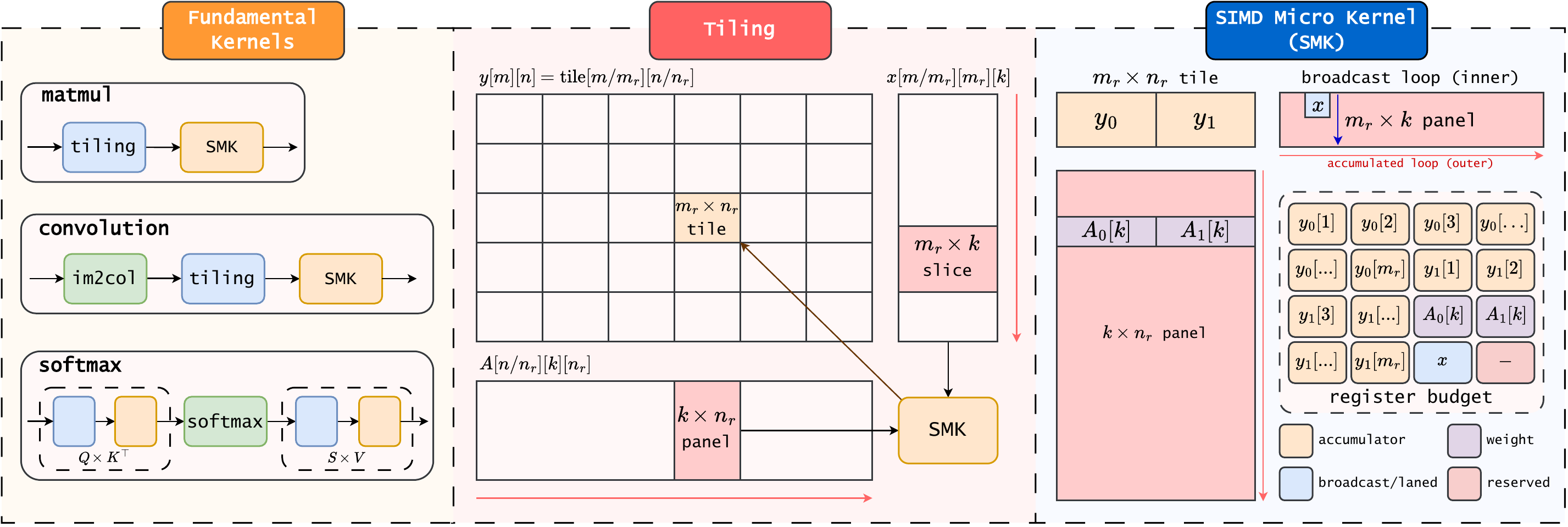
vla.simd. Linear layers, convolutions via panel im2col, and attention
projections share one packed-panel SIMD micro-kernel, whose register tile is selected per target
(6×16 on AVX2, 4×16 on NEON). Work is organised by lifetime: weights are packed once per process,
instruction-dependent tensors once per episode, and each query computes only observation-dependent
features.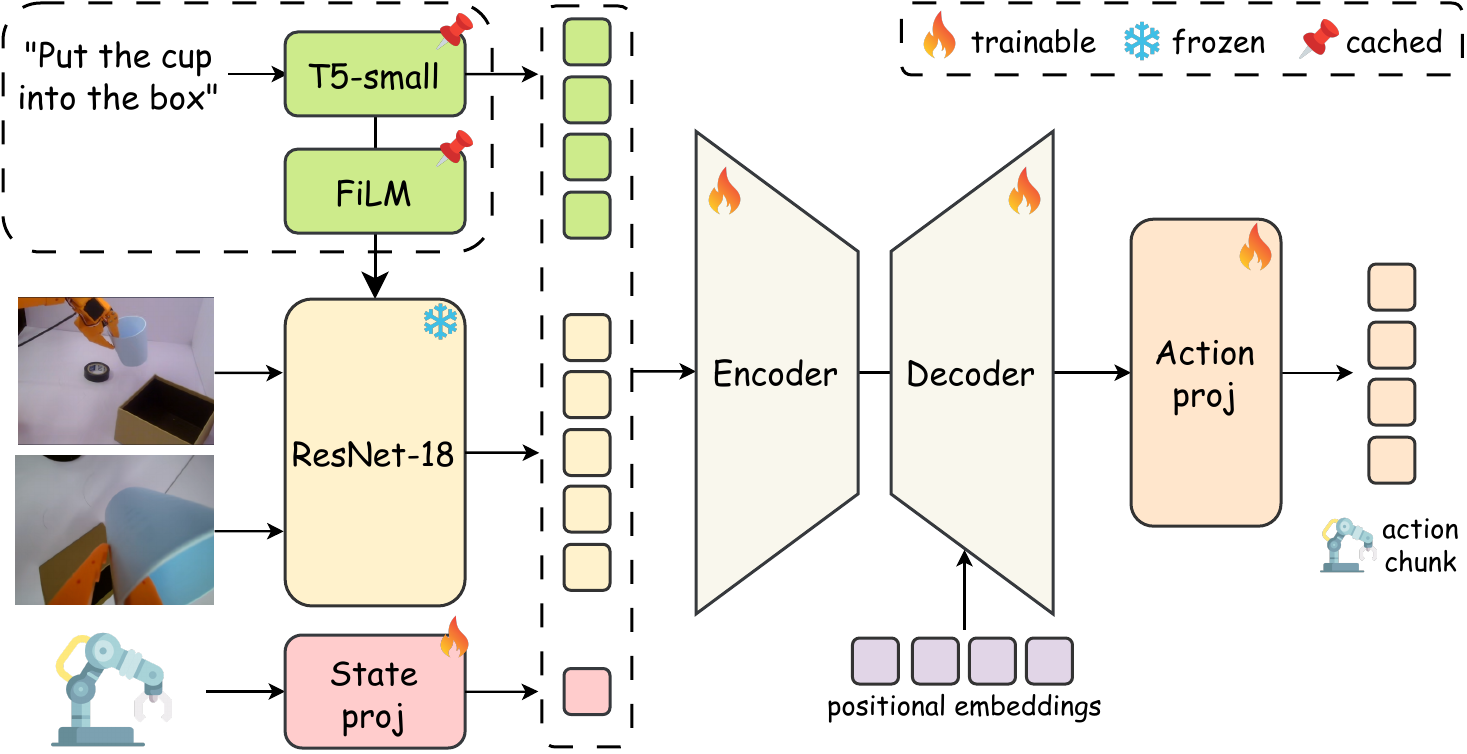
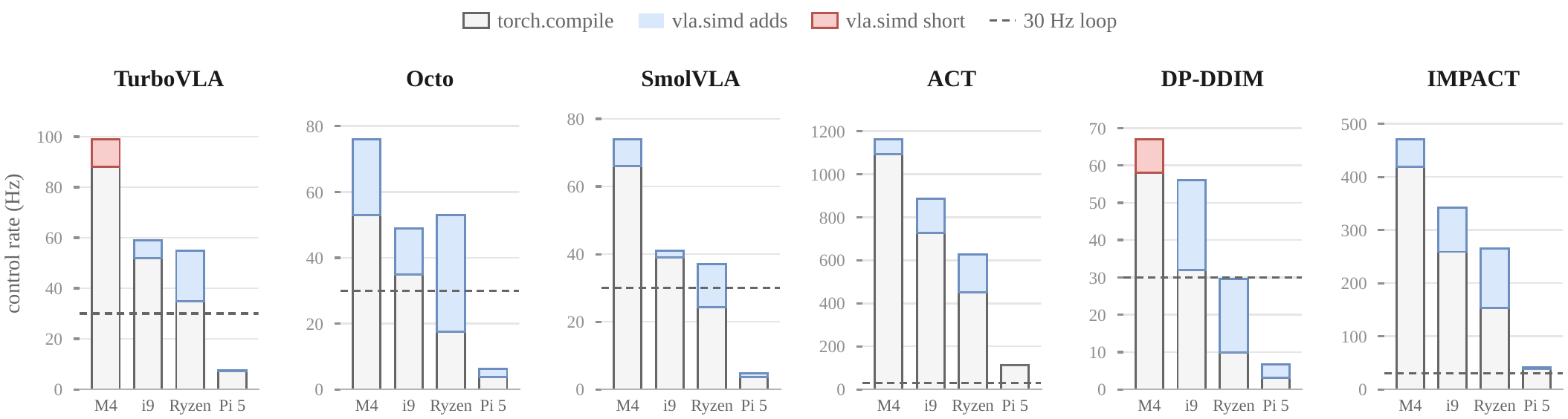
vla.simd, red segments a loss; the dashed line marks the 30 Hz budget. On the Ryzen,
Octo-Small and SmolVLA cross that line with vla.simd.Real-robot experiments
Four conditions on an SO-101 arm, 20 episodes each. Success rates and 95% confidence intervals are those reported in the paper; latency is the mean query roundtrip on that bench.
SO-101 · AInstruction following in a shared scene
IMPACT, fp32. The scene is fixed and holds both objects; only the instruction changes.
so101-impact-tape-box.mp4
so101-impact-tape-cup.mp4
so101-impact-cup-box.mp4
SO-101 · BLong-horizon drawer task
Open the drawer, place the tape inside, close it. Twenty demonstrations, a separate checkpoint.